
How tarot works is almost as much a mystery to me as it is to querents. When I shuffle the cards, I can feel a tingling in my fingers. When I look at a layout, the meanings of individual cards swirl and coalesce into a story for that querent at that particular time. I relay what that story is, and the querent is free to decide how the reading fits their circumstances.
But that all sounds so very esoteric that I can totally understand why some people doubt or scoff. I did myself, until I’d done quite a few readings for people and been eerily accurate every time. I’ve had too many experiences where my readings were absolutely spot on, despite me knowing absolutely nothing about the querent’s circumstances, to think that it’s purely random. (Some of those instances are described in the FAQ.) Perhaps I pick up some unspoken vibe, or perhaps I “know” in some other way and I only think the cards are the conduit, or perhaps the cards really do sort themselves into an appropriate order. Who knows? People do doubt, though, and that’s perfectly okay. I keep my costs quite low so that those who are unsure about it don’t have to outlay too much money on a risk.
People often ask how emailed tarot readings can work. It’s a fascinating question, because the underlying assumption is that “real” readings only work when face to face, despite that allowing more room for accusations of guessing from nonverbal cues. By email, such indirect ‘help’ simply isn’t there. My email readings are done without seeing either positive or negative feedback in real time, so they’re completely unaffected by either. Despite that, my accuracy rate is extremely high, so whatever vibes are involved work quite well over the internet. In fact, I quite like doing readings for people I don’t know at all, because it shows the accuracy so much better.
Here’s how it goes:
You request a reading and I confirm the booking, allocate you a payment code, and ask you three basic questions about your looks and personality. You answer those questions and pay for the reading, citing as a reference the payment code I’ve given you. Once the reading is confirmed, questions are answered and payment is made, I will do your reading within three days.
The answers to the questions (along with your actual-usage first name, not an online nickname) allow me to pick up your vibe. I focus on that concept of you as I shuffle the cards, and then I lay them out and make notes on the reading as I see it. I then write it out in full, email it to you, and clarify any points you may not fully understand.
Pricing
(see FAQ at the foot of the page for more info about what’s included in each)
Standard reading: $35
Additional detail: $15 (only as follow-up to standard reading; must be requested within 48 hours after standard reading)
Combined standard reading + specific question: $45
Short reading: $20
To request a reading, fill in the details in the form below. I will allocate you a reading code, which you should use as a reference on your payment and all correspondence. Or, if you wish to ask more before making a decision, please select “General Enquiry” in the drop-down menu.
Tarot reading is quite draining, so I have limited slots available each week. Please be patient if I cannot do your reading as soon as you would like it.


YOU MUST WAIT FOR ME TO CONFIRM YOUR BOOKING BEFORE PAYING!!
.
PAYMENT OPTIONS

Standard tarot reading
A$35.00
Additional detail
A$15.00

Combined standard + specific question
A$45.00
Short reading
A$20.00
Dadirri Tarot FAQ
- WHAT’S INCLUDED IN A READING? A standard reading includes some description of your past, your current circumstances and upcoming things. It also describes a problem that you are having at the moment and a way to break through obstacles. Doing the reading and emailing the result to you usually takes me about an hour. Once you receive the reading, one response from you asking for clarification, and my reply to that, is included in the standard charge. Additional detail asks me to explore one section of your standard reading in greater detail, and includes a conversation of up to three emails each. Because it requires me to re-create the reading layout, it costs an additional fee. It must be requested within 48 hours of the time stamp on my emailed reading. A short reading is designed to elicit an answer or insight about a single issue, and uses a smaller card layout. A combined standard + specific question reading includes exploring the answer to a specific question at the same time as I do the standard reading.
- HOW SPECIFIC ARE THE READINGS? It varies somewhat, depending on how well I connect with your vibe and how clearly the messages in the cards come to me. I try to be as specific as possible, but being more specific than my knowledge merits can mislead the querent. That said, many of my readings have included quite specific mentions of things that I can’t possibly know otherwise. For example, one reading I did included the statement that the querent had a health problem related to water retention, and that even though it seemed counter-intuitive she should drink more water rather than less. After giving her the information, she told me she had recently been diagnosed with diabetes, and had been drinking very little in an attempt to reduce her urination frequency.
In another reading, which was specifically about whether the querent should buy a house she was looking at, I was able to describe the frontage of the house and certain architectural features inside, and tell her that there was water at the back of the property. Every detail was correct. - DON’T PEOPLE JUST TWIST WHATEVER THE READING SAYS TO MAKE IT FIT THEIR LIVES? It’s true that people can do that, but a personal reading is very different from, say, reading your star sign in the newspaper. Intuitive messages designed to apply to a large population are totally unlike a specific reading for your life right now. Many years ago, I did two email readings back to back; both querents were completely unknown to me (apart from the standard information I’d asked for), and the querents were not connected to each other at all. I did their readings, then emailed the information to them, but… I mixed them up, and sent A’s reading to B and B’s reading to A. (Don’t worry; there’s never any identifying information in a reading, and I’ve changed my system so that a mix-up like that can’t happen again.) I realised what I’d done within about half an hour, and promptly sent the correct readings to each of them. Both of them, in replying, said that they were relieved to have received their real readings, because the first one hadn’t made any sense at all, but the second one was spot on. So you see, a personal reading is specific enough that either it does fit, and you know it does, or it just doesn’t and you can’t make it do so.
- AREN’T YOU TELLING THE FUTURE, AND ISN’T THAT WRONG? Readings clarify choices you can make, and give some guidance as to the likely course of events, but no – predicting the future with any certainty is not what it’s about. I like to say that tarot is a means of tapping into the well of knowledge in your subconsciousness, so that you can see your past, present and future more clearly. My standard reading includes some description of your past, so that you have a means of gauging the accuracy of the reading, some description of your current situation, and some likely future circumstances. Sometimes I do see clear visions of things that are coming to a querent, but these can just as legitimately be called prophecy as fortune-telling.
- HAVE YOU EVER FORESEEN SOMEONE’S DEATH? No, although I did do one reading that was nearly as dramatic. I had gone through my usual routine of asking for basic info, and then I did the reading 3 days later. It included details about what was happening for the querent in the present: that she was totally changing who she was, erasing who she had been, cutting off ties with people and becoming a completely new person. It was the kind of reading that makes a reader worry about what can of worms they might be uncovering for the querent, especially if the events haven’t actually happened yet. In this case I wondered if she had gone, or was about to go, into witness protection! 🙂 A couple of hours after I sent it, I got an email from her asking when I’d actually laid out the cards. I told her that it had been an hour or so before I sent the completed reading. She then explained that in the 3 days between when she’d sent the information to me and when I’d done the reading, she’d discovered that someone was stalking her in a closed internet group. After discovering it, she had changed her group username, removed all links to her former identity, and deleted all her previous posts – thus completely changing her (online) identity!
But apart from that instance, the nearest thing has been seeing in the cards that a querent was re-writing his will, and identifying what circumstances were prompting him to do so and what issues he was addressing in the changes. - WHAT ABOUT CONFIDENTIALITY? Confidentiality is crucial! Much of the work that I do allows me to get to know very personal information about my clients. I hold all such information in the strictest confidence, and abide by the highest codes of professional ethics.
- WHAT’S A QUERENT? AND WHAT’S AN ARCANA? Here’s a brief list of tarot terms:–
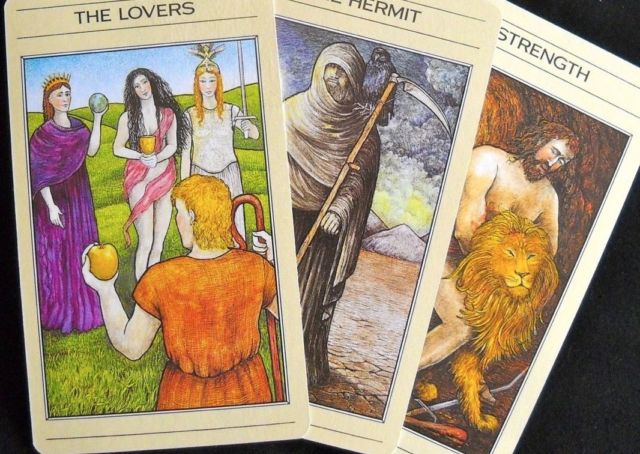
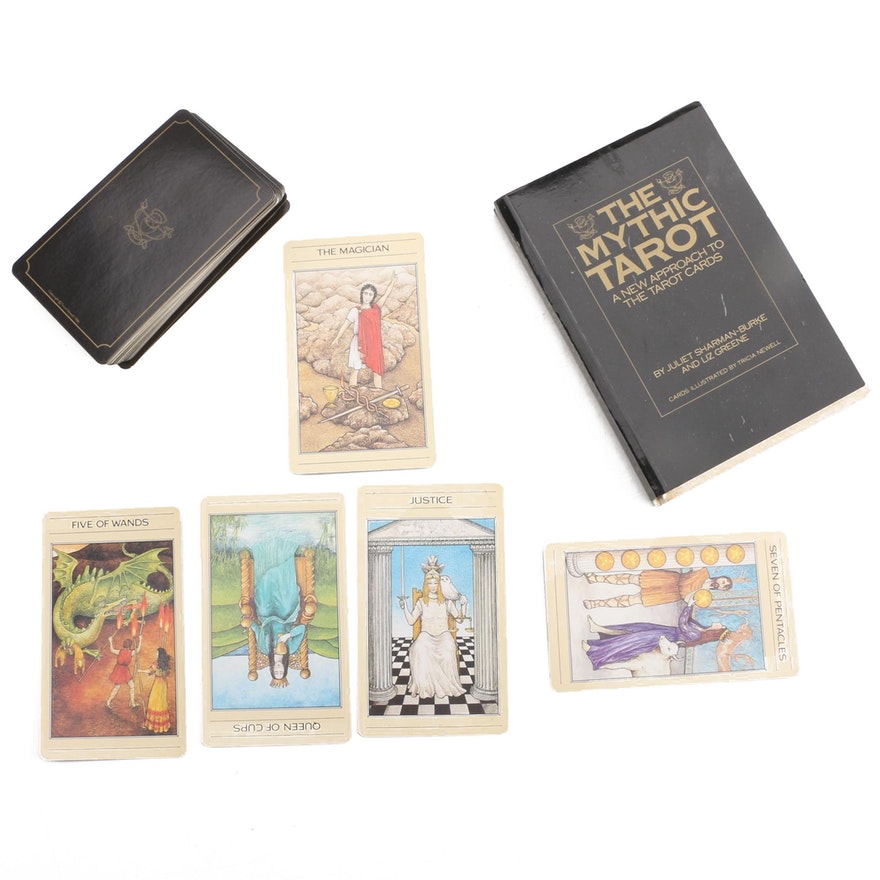
Tarot – a collection of 78 cards depicting various archetypes, which a reader uses to gain insight into the physical, psychological and metaphysical circumstances of the querent. There are hundreds of differently-themed tarot decks; my personal favourite is the Mythic deck, which is based on stories from Greek mythology.
Reader – the person doing the reading (unless you go all fancy and say cartomancer)
Querent – the person asking for a reading
Layout, or spread – a pattern in which the cards are laid out. Usually each position within the layout holds a constant meaning. There are some universally-recognised layouts, but most experienced readers develop their own.
Arcana – the word literally means ‘hidden’, and refers to the hidden meanings that can be drawn from the cards. A tarot deck is divided into the major arcana (the especially outstanding cards, such as ‘The Fool’ and ‘Death’) and minor arcana (similar to a standard deck of playing cards).
 Dadirri Life Melodies